
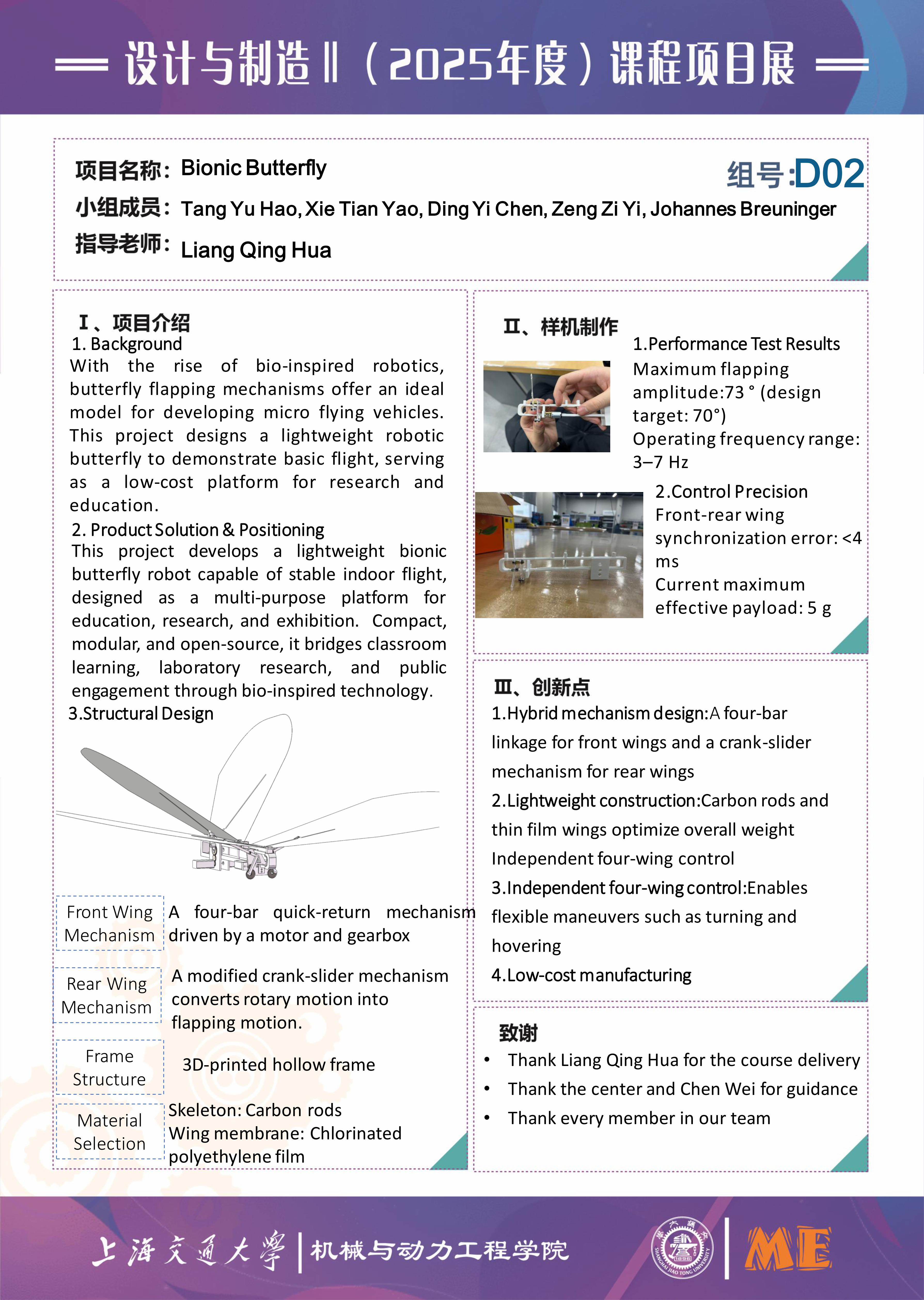
To achieve basic flight and movement functions of micro-bionic aircraft in simple environments, this study designed, manufactured, and tested a bionic butterfly robot inspired by the morphology and flight patterns of natural butterflies. First, we observed and analyzed the wing structure and flapping characteristics of real butterflies to determine the fundamental design parameters for the robot's wings and fuselage. Next, we designed the robot structure based on bionic principles: using lightweight materials for the fuselage and wing frames, flexible materials to simulate butterfly wing membranes, simple drive mechanisms and transmission structures to enable wing flapping motions, and integrated basic electronic components to control flight direction. Finally, we tested the robot's performance in indoor scenarios. This study successfully developed a bionic butterfly robot with basic flight capabilities, providing practical references for future improvements and laying the foundation for its application in simple scenarios such as science education demonstrations.
This project focuses on developing a bionic butterfly robot with basic flight capabilities. Based on the morphological features and flight characteristics of real butterflies, the project is divided into three core phases: observing real butterflies and determining parameters, structural design and manufacturing, and performance testing. In the initial phase, our team analyzed the wing structure, flapping frequency, and flight posture of real butterflies to determine key design parameters such as the body size, wing dimensions, and flapping amplitude of the bionic butterfly. During the design and manufacturing phase, lightweight materials were used to construct the body and wing frames to reduce overall weight, while flexible materials were employed to simulate the membrane structure of butterfly wings, ensuring the feasibility of flapping motions. Simultaneously, basic flapping movements were achieved by installing simple drive mechanisms and transmission structures, with fundamental electronic components integrated to control flight direction. In the final performance testing phase, the robot was tested in a simplified indoor environment to verify its flight stability, basic movement capabilities (such as forward flight, steering, and hovering), and ability to navigate narrow spaces.
During the project implementation, our team developed a biomimetic prototype using real butterflies as the reference. We systematically completed three core phases: First, by analyzing the wing structure, flapping patterns, and flight dynamics of real butterflies, we scientifically determined the key design parameters for the robot. Second, lightweight flexible materials were selected to construct the robot's structure, which was then equipped with simple yet reliable drive mechanisms and electronic control components. Finally, through indoor performance testing, we optimized the structural design.
It should be noted that the project still has notable limitations. On one hand, the bionic butterfly ultimately failed to achieve smooth flight; on the other hand, the electronic control components have relatively low integration, and the battery life requires further improvement. Moreover, compared to advanced products like the FESTO Ultra HD Butterfly, the robot developed in this project still falls short in wing surface control precision and aerodynamic performance.